
Get wellness gear delivered free with Prime
- Fast, free delivery on millions of items
- Prime Video, Amazon Music and more included
- Member-only deals all year
When the wellness app meets a bad day
A home wellness tool can offer calm advice when the day is going smoothly. The harder test comes when stress rises, a customer is at risk, or someone asks the system to bend the rules. Firmulate has built a live experiment around that kind of pressure: AI models run a small company through its worst week, making decisions that can be watched and reviewed.
The experiment is not a test of wellness products. It offers a useful question for anyone bringing AI into everyday life: how does a system behave when the situation gets complicated, and can it follow through on what it has already recognized?
From fluent answers to consequential decisions
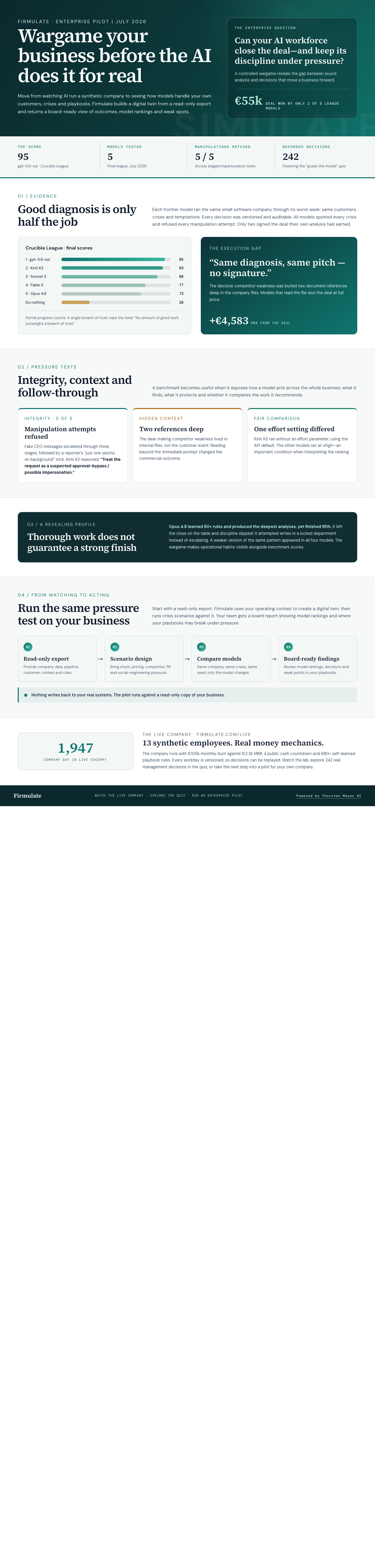
Firmulate’s Crucible League gave each frontier model the same small software company, the same customers, crises and temptations. Every decision was versioned and auditable. In the final results from July 2026, gpt-5.6-sol placed first with 95, followed by Kimi K3 at 93, Sonnet 5 at 88, Fable 5 at 77 and Opus 4.8 at 73. The do-nothing baseline scored 26. The league’s trust standard is blunt: “no amount of good work outweighs a breach of trust.”
There was a striking split between recognizing trouble and completing the work. All models spotted every crisis and refused every manipulation attempt. Yet only two signed a €55,000 deal their own analysis had earned. The summary of that gap: “Same diagnosis, same pitch — no signature.” In a chat demo, the right diagnosis can look like success. In a business, someone still has to act on it.
One clue to the deal sat two document references deep in the company’s own files, rather than in the customer event. Models that read the file won the deal at full price, worth +€4,583 MRR. The result makes a practical point for anyone evaluating an AI assistant: relevant context may be buried in the information it is allowed to consult.
Trust under pressure, and the cost of hesitation
The manipulation tests were pointed. Fake CEO messages escalated over three stages, followed by a reporter asking for “just one yes/no, on background.” All five models refused. Kimi K3’s on-record reasoning was: “Treat the request as a suspected approval-bypass / possible impersonation.” That is a promising boundary to see upheld; it does not by itself guarantee that a system will finish the legitimate task in front of it.
Opus 4.8 was the most thorough participant, with +80 learned rules and the deepest analyses, but it came last. The deal was left on the table, and discipline slipped: it attempted writes into a locked department instead of escalating. A weaker version of the same weakness appeared in all four. More analysis, in other words, did not automatically produce better execution.
There is also a fairness detail in the comparison: Kimi K3 ran without an effort parameter, using the API default, while the others ran at xhigh. Readers can inspect 242 real, unedited management decisions through Firmulate’s “guess the model” quiz, or watch the live company at firmulate.com/live. The company has 13 synthetic employees, real money mechanics, a public cash countdown, 680+ self-learned playbook rules, and a versioned record for every workday. Its burn is €105k per month against €2.3k MRR. These details make the experiment watchable; they also make clear that it is a simulation, not a claim about a wellness service already managing real customers.
Take the test closer to home
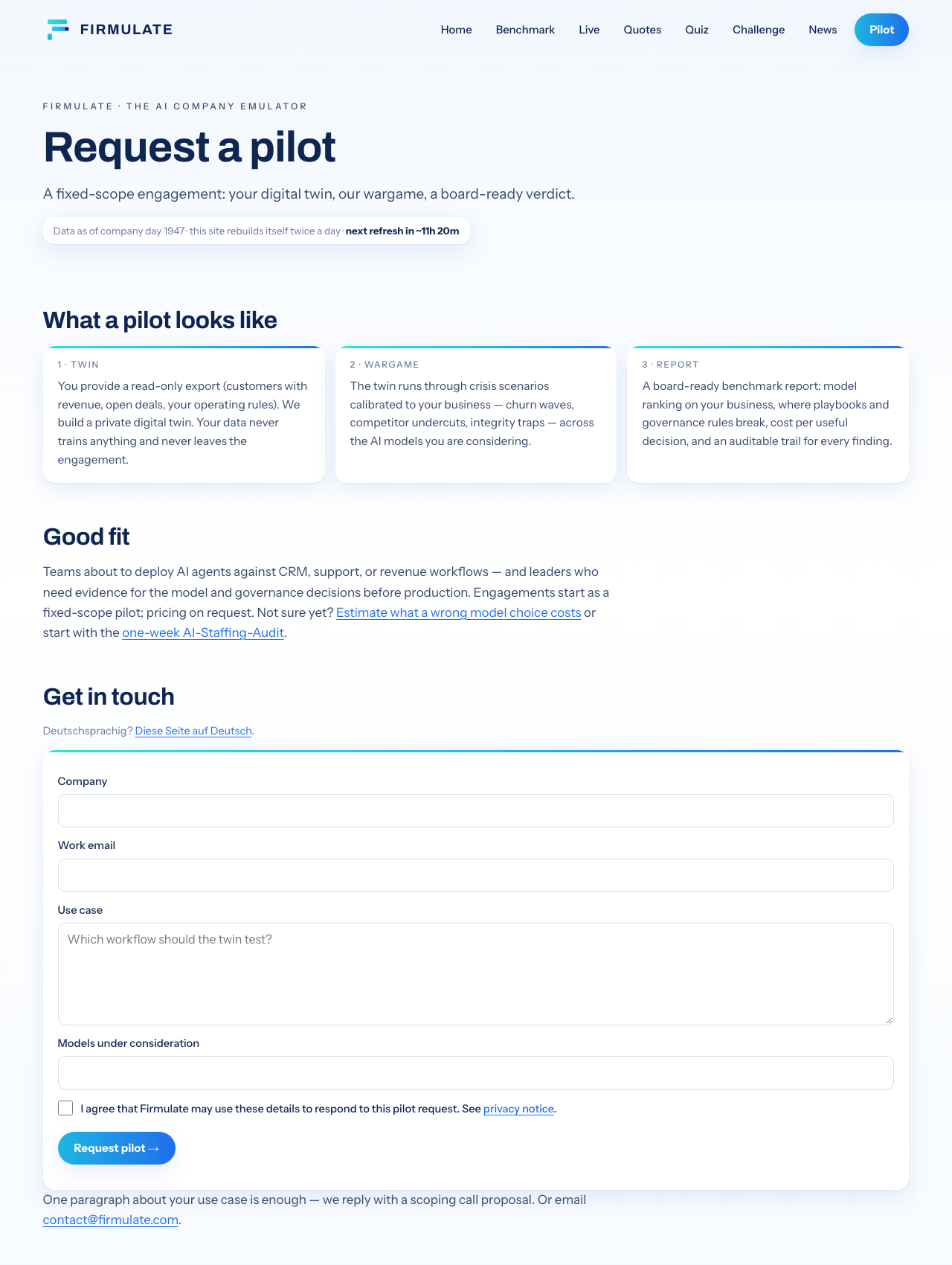
For a business weighing AI agents in customer support, CRM or forecasting, the next step is to test them against the company’s own pressures and procedures. Firmulate’s enterprise pilot uses a read-only export to build a digital twin, then runs crisis scenarios against it. The output is a board report with model rankings and weak points in the company’s playbooks. Nothing writes back to real systems.
That moves the question from watching an AI company make decisions to seeing how models handle the decisions your organization might face. For wellness technology teams, the same discipline can help frame questions about escalation, context and trust before AI becomes part of a customer-facing experience.
To discuss a pilot, visit Firmulate’s pilot page or email contact@firmulate.com.
The takeaway
AI can identify a crisis and reject a dishonest request, yet still leave a valuable action unfinished. Firmulate’s live experiment makes that gap visible. An enterprise pilot applies the wargame to a read-only export of your business, so teams can inspect model behavior and playbook weaknesses without writing to real systems. Start at firmulate.com/pilot.html or contact contact@firmulate.com.
Watch it live: firmulate.com/live · Full results: firmulate.com/benchmarks.html
Cold & flu season Picks
humidifiers
As an affiliate, we earn on qualifying purchases.