TL;DR

Get wellness gear delivered free with Prime
- Fast, free delivery on millions of items
- Prime Video, Amazon Music and more included
- Member-only deals all year
Fit&Well published a yoga teacher’s five-pose flow, described as taking about two minutes, for clients seeking a short pause during a stressful day. The sequence pairs gentle movements with three to five breaths in each pose; its effects on stress are not established by the report.
Fit&Well has published a yoga teacher’s five-pose flow, described as taking about two minutes, which she gives clients as a short way to pause during a stressful day. The sequence moves from cat-cow through downward-facing dog, an eight-point salute and cobra, finishing in child’s pose; the teacher advises taking three to five breaths in each pose.
The teacher frames the routine as an opportunity to combine gentle movement, slower breathing and attention to bodily sensations. She says she encourages yoga therapy clients to use it when they need to recalibrate during the day. The article presents this as her teaching approach, not as evidence that the sequence treats a medical condition or produces a guaranteed effect.
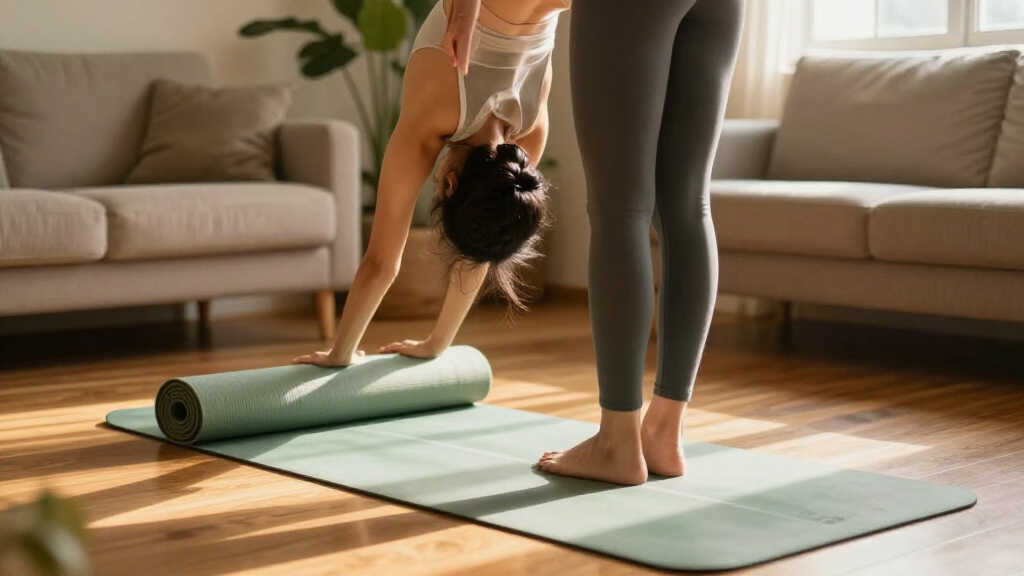
To begin, practitioners come onto their hands and knees for cat-cow, arching the back on an inhale and rounding the spine on an exhale. They then lift their hips into downward-facing dog, with bent knees allowed for comfort, and may pedal their feet while keeping attention on the breath.
From there, the sequence goes to a high plank and then an eight-point salute, lowering the knees, chest and chin while keeping the hips raised. The practitioner moves onto the stomach for cobra, lifting the chest while the pelvis stays grounded, before returning to kneeling for child’s pose. The source says to modify the lowering movement by bringing the knees down first if needed, and to rest the forehead on the floor or hands in the final pose.
A Short Pause Built Around Breath
The routine’s appeal is its short, structured format: the teacher describes a sequence that can fit into a break rather than requiring a full class or a fast-paced workout. Its instructions also emphasize noticing contact with the floor and the movement of each exhale, giving participants a concrete focus instead of asking them simply to think their way through a difficult moment.
That is a description of the teacher’s rationale, not proof of a clinical outcome. The article reports no study, measurement or comparison showing that this particular flow reduces stress or changes nervous-system activity. Readers should understand it as a brief movement and breathing practice, with individual experiences likely to vary.
As an affiliate, we earn on qualifying purchases.
How the Five Poses Fit Together
The teacher recommends three to five breaths per posture and says the emphasis should be on awareness rather than speed. The routine links familiar floor-based yoga shapes in a continuous progression: a spinal movement on hands and knees, an inverted pose, a short lowering sequence, a gentle backbend and a resting posture.
She notes that people accustomed to dynamic yoga may find it challenging to move slowly. In her account, slowing down is part of the exercise: noticing the body’s contact points, following the exhalation and observing each movement. The source does not provide a timed breakdown for each pose, so the stated two-minute duration should be treated as the routine’s approximate description rather than a precise schedule.
““It’s nearly impossible to regulate your nervous system with mental reasoning alone.””
— The yoga teacher, as quoted in Fit&Well
As an affiliate, we earn on qualifying purchases.
Evidence and Individual Limits
Fit&Well’s report does not identify the teacher by name in the supplied material, give a publication date or cite research testing this exact five-pose sequence. It also does not specify whether the two-minute estimate includes transitions or how long participants should remain in each posture beyond the suggested breath count. The claimed stress-management benefit is therefore the teacher’s stated purpose, not a measured result in the article.
The instructions offer a few adjustments, including bending the knees in downward-facing dog and lowering them first in the eight-point salute, but they do not cover every mobility or health concern. Anyone who experiences pain, dizziness or discomfort should stop or modify the movements; people with injuries or relevant health conditions may wish to ask a qualified health professional before trying the sequence.
As an affiliate, we earn on qualifying purchases.
Using the Flow at Your Pace
The source gives no announced follow-up, trial or additional reporting on the routine. Readers who choose to try it can follow the poses in order, use the suggested three to five breaths per pose and keep the movements comfortable rather than forcing a particular shape. The teacher’s guidance is to move slowly and pay attention to breathing and bodily sensations.
The next practical step is personal, not a formal milestone: stop if a posture causes pain, adjust the range of movement or leave out a pose that does not feel suitable. The report does not establish that the sequence works for everyone, and it should not be treated as a replacement for professional care when stress or other symptoms require support.
As an affiliate, we earn on qualifying purchases.
Key Questions
What poses are in the two-minute flow?
It includes cat-cow, downward-facing dog, eight-point salute, cobra and child’s pose, in that order.
How long should I stay in each pose?
The teacher recommends taking three to five breaths in each posture. Fit&Well describes the full sequence as two minutes but does not give exact timings for transitions.
Does the article prove the flow reduces stress?
No. The teacher says she gives the sequence to clients to help them manage stress, but the report does not cite research or measurements showing that this specific routine reduces stress.
Can the poses be modified?
The instructions say to keep the knees bent in downward-facing dog if that is more comfortable and to lower the knees first during the eight-point salute if needed. Stop or adjust if a movement causes pain or discomfort.
Source: rss
Fall Picks
fall essentials
As an affiliate, we earn on qualifying purchases.