TL;DR

Get wellness gear delivered free with Prime
- Fast, free delivery on millions of items
- Prime Video, Amazon Music and more included
- Member-only deals all year
Boston-based Pilates instructor Julie Erickson recommends a three-move sequence—roll up and down, swan prep, and spine twists—for mobility and back strength. The routine is presented as a way to support posture and reduce stiffness, but the report provides no evidence that it is the quickest method or a guaranteed fix.
Boston-based Pilates instructor Julie Erickson, founder of Endurance Pilates and Yoga, recommends a sequence of three exercises—roll up and down, swan prep and spine twists—to support mobility and back strength for people who spend long periods sitting. Fit&Well describes the routine as a quick way to improve posture and reduce stiffness, but the material supplied does not establish that it is the fastest approach or provide evidence of specific results.
The sequence begins with eight to 10 roll ups and roll downs. Sit with legs extended and arms reaching forward, then slowly roll the torso toward the floor, reach the arms overhead and bring them back up. Curl the upper body to return to sitting, roll forward over the legs and sit upright again. The report suggests making the move easier by rolling down only partway or securing the feet under a strap or couch.
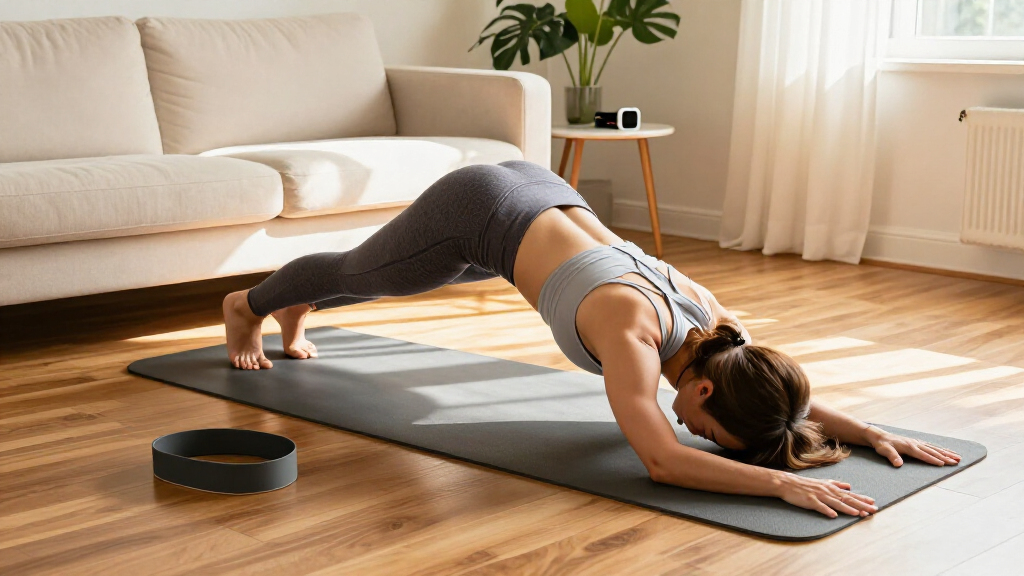
Next is swan prep, for five repetitions. Lie face down with palms on the mat beside the ribcage and elbows bent. Press through the hands to lift the chest, draw the shoulders back and keep the neck long, then lower slowly. The report describes a harder variation in which the chest lifts higher and the arms straighten, if the person can do so comfortably.
The final move is five spine twists on each side. Sit with legs extended and arms out to the sides. Keeping the hips and lower back still, lengthen the spine and rotate the ribcage to one side; exhale and rotate a little further before returning to centre and repeating on the other side. Erickson’s advice is presented as an instructor recommendation, not as a clinically tested program or a promise of improvement.
A Short Routine for Desk Stiffness
The routine offers readers a brief set of movements that can be tried without specialist equipment, with modifications listed for two of the exercises. Its focus on spinal movement and back engagement may appeal to people seeking a structured break from prolonged desk or phone use. That practical appeal does not establish that the sequence will correct posture or relieve stiffness for every person.
The distinction matters because the headline’s “quickest way” wording is not supported by comparative evidence in the supplied report. No study, measurement period or comparison with other exercise approaches is provided. Readers can treat it as one instructor’s suggested routine rather than a proven shortcut, and should stop if a movement causes pain. People with injuries, persistent symptoms or relevant health conditions may want professional guidance before starting.
Pilates roll up and down exercise equipment
As an affiliate, we earn on qualifying purchases.
As an affiliate, we earn on qualifying purchases.
The Instructor’s Desk-Work Rationale
Fit&Well frames the advice around hours spent sitting at a desk and looking down at a phone, which it says can affect posture. Erickson’s proposed response combines a controlled roll through the spine, a prone chest lift and seated rotation. The exercises use different positions and movement directions rather than repeating a single motion.
The report says that regular practice can support mobility and back strength, making it easier to sit and stand upright. That is the instructor’s stated rationale as relayed by the publication; the material does not specify how often to do the routine, how long to continue it, or what outcomes were observed in participants. The exercises and repetition counts are the concrete guidance provided.
“the quickest way to improve your posture and reduce stiffness”
— Fit&Well headline
As an affiliate, we earn on qualifying purchases.
How Fast Results May Appear
The supplied report does not identify a research study or comparison supporting the claim that this is the quickest way to improve posture. It also gives no timeline for results, recommended weekly schedule, or measure of how much stiffness or posture may change. The phrase “done regularly” is not defined by a specific frequency or duration.
It is also unclear how the sequence would suit people with different levels of mobility, pain or prior injury. The easier and harder variations offer some adjustment, but the material does not provide a full screening process or individual assessment. The claimed benefits should not be read as guaranteed outcomes, and the report does not say that the exercises replace medical care.
adjustable spine twist exercise tool
As an affiliate, we earn on qualifying purchases.
As an affiliate, we earn on qualifying purchases.
How to Use the Routine Safely
The immediate next step for readers interested in the sequence is to try the listed movements at a comfortable range, using the suggested easier options where appropriate. The supplied material provides no formal progression plan or schedule, so it does not support a precise recommendation for how often to repeat the full routine. People should avoid pushing through pain and can ask a qualified Pilates instructor to check their form.
No further study, follow-up or additional guidance is announced in the source material. Whether the routine produces measurable posture or stiffness changes—and how quickly—remains unreported. People with ongoing pain, an injury or a health condition should seek guidance from an appropriate health professional before beginning new exercises.
back mobility and posture support products
As an affiliate, we earn on qualifying purchases.
As an affiliate, we earn on qualifying purchases.
Key Questions
Which three Pilates moves does Julie Erickson recommend?
She recommends roll up and roll down, swan prep and spine twists, according to Fit&Well.
How many repetitions does the routine list?
The report gives eight to 10 repetitions for roll ups and roll downs, five for swan prep, and five spine twists on each side.
Is this proven to be the quickest way to improve posture?
The supplied material does not cite comparative research establishing that it is the quickest method. The wording is a claim in the publication’s framing, not a demonstrated result.
What if an exercise is difficult or uncomfortable?
Fit&Well suggests rolling down only halfway or securing the feet for the roll-up exercise. Do not push through pain; people with injuries, persistent symptoms or relevant health conditions should seek professional advice before exercising.
Source: rss
Columbus Day / Indigenous Peoples' Day Picks
long weekend sales
As an affiliate, we earn on qualifying purchases.