TL;DR

Get wellness gear delivered free with Prime
- Fast, free delivery on millions of items
- Prime Video, Amazon Music and more included
- Member-only deals all year
A Fit&Well contributor and yoga therapist says she used legs up the wall after a 10-hour hike in the Albanian Alps to rest her tired legs. The pose may offer gentle stretching and a quiet recovery routine, but the source does not provide clinical evidence that it speeds recovery or improves sleep.
Fit&Well has published a first-person report in which a yoga therapist describes using legs up the wall after a 10-hour hike across the Albanian Alps. The account offers readers a simple, adjustable way to rest after a long walk, while its proposed effects on circulation, stress and sleep are the author’s explanations rather than findings established by evidence cited in the report.
The author says she returned to her guesthouse after the hike and lay on a bed with her legs raised. She identifies the posture as viparita karani, its Sanskrit name, and says she chose it for tired legs. The article presents the routine as a personal recovery practice, drawing on the author’s nearly 20 years as a yoga student and her work as a yoga therapist.
To try the pose, sit sideways beside a wall or bed headboard, then turn onto your back as you swing your legs upward. The article suggests placing a pillow under the head for comfort and adjusting how close you are to the wall so the knees can bend if needed. Hands can rest on the abdomen or beside the body while breathing slowly.
People who find a wall uncomfortable can rest their lower legs on a couch or chair instead, according to the report. To come out, bend the knees, roll onto one side and sit up. The author also mentions holding the legs unsupported, though the report does not give a duration for the pose or a specific progression.
A Rest Stop After Long Walks
Long hikes can leave the legs feeling tired and stiff, and the report argues that taking time to rest may help walkers feel more comfortable after demanding outings. Legs up the wall is presented as a low-effort option that does not require equipment beyond a wall, bed, or substitute surface such as a chair.
The practical value is its adaptability: walkers can bend their knees or support their lower legs instead of forcing a straight-leg position. That makes the posture easier to tailor to comfort. The report’s claims that elevation can ease puffiness and that the pose activates the body’s rest response are not backed by study details in the source, so readers should treat them as the author’s rationale rather than guaranteed outcomes.
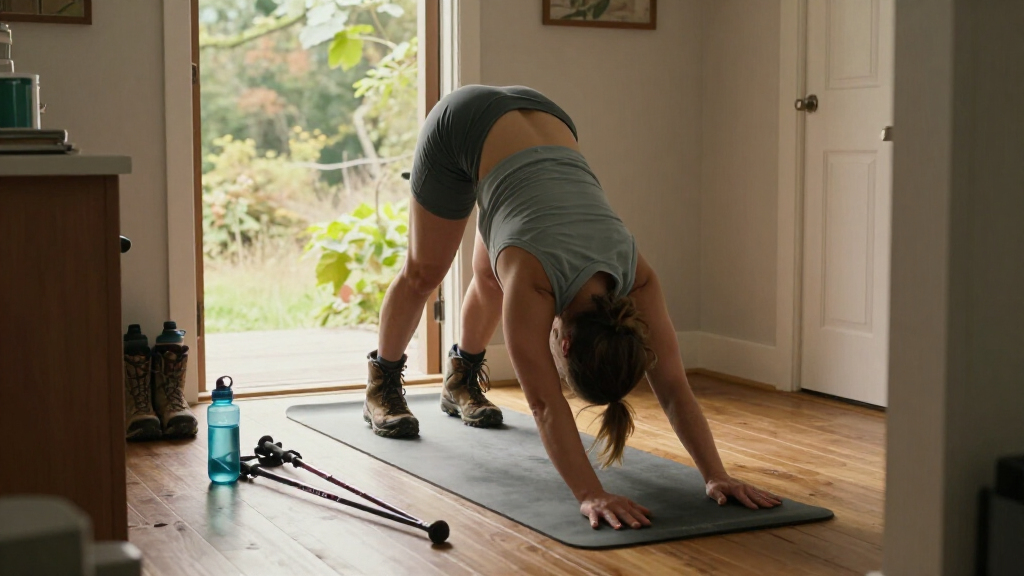
The report begins from the idea that walking, hill climbs and hikes are ways to stay active and spend time outdoors. Its author says stiff muscles can affect joint mobility and potentially make later hikes less comfortable. She recommends active recovery as a consideration after a demanding walk, including gentle stretching and a chance to settle after physical exertion.
Her account centers on one specific outing: a 10-hour crossing of the Albanian Alps during a summer trip. The source does not identify the year, route, elevation gain or conditions. It also does not compare this posture with other recovery methods. The article is therefore a personal report with practical instructions, rather than a study of post-hike recovery.
““That’s why I turn to yoga for my post-hike recovery.””
— Fit&Well report author, a yoga therapist
What the Report Does Not Establish
The source does not cite research showing that legs up the wall speeds muscle recovery, reduces swelling, lowers cortisol or improves sleep. Those effects are presented as explanations in the report, not as measured outcomes from the author’s hike. It is also unclear how long the author held the pose, how often she uses it, or whether it changed her recovery.
Individual comfort and mobility vary. The report offers adjustments but does not set out screening guidance for people with health concerns or pain. Anyone unsure whether an inverted or elevated-leg position is appropriate for them can seek guidance from a qualified health professional; the pose should be stopped if it causes discomfort.
How Walkers Can Try the Pose
The article gives no follow-up study or planned update. Readers interested in trying the routine can follow its basic setup after a walk, choosing a wall or a chair to support the legs and adjusting the knee bend for comfort. A slow exit—knees bent, roll to one side, then sit up—is part of the instructions.
Whether the pose feels restorative will depend on the individual. The report supports viewing it as an optional rest practice after a strenuous outing, rather than a proven treatment or a substitute for other recovery needs.
Key Questions
What pose does the report recommend after a hike?
It recommends legs up the wall, also called viparita karani, as a pose the author uses to rest after a long hike.
How do you do legs up the wall?
Sit sideways next to a wall, lower your back to the floor or bed, and swing your legs up. Adjust your distance so your knees can bend, and use a pillow under your head if comfortable.
Can I do the pose without a wall?
Yes. The report suggests resting your lower legs on a couch or chair as an alternative. It also mentions raising the legs unsupported if that feels comfortable.
Does the pose have proven recovery or sleep benefits?
The Fit&Well report describes possible effects on tired muscles, stress and sleep, but it does not cite clinical evidence or report measured results. Those benefits should not be treated as guaranteed.
Source: rss
Columbus Day / Indigenous Peoples' Day Picks
long weekend sales
As an affiliate, we earn on qualifying purchases.