TL;DR
Open a free Amazon Business account
Business pricing, bulk buying and tax-exempt orders.
Create a free accountAs an affiliate, we earn on qualifying purchases.
Most couples find two separate weighted blankets easier and more personalized, especially if they differ in size or temperature needs. Sharing one blanket can work if both partners have similar preferences, but safety and comfort are key. Start with individual blankets if unsure.
Two individual weighted blankets usually offer better comfort and safety, especially if partners differ in size, temperature, or pressure preference.
Always prioritize safety—avoid weighted blankets if you have respiratory, circulatory, or mobility issues without consulting a healthcare professional.
Choose the right size, weight, and fabric based on personal needs, not just mattress size or generic rules.
Breathable fabrics and removable covers help prevent overheating and simplify maintenance.
Start with one or two blankets during a trial period to find what truly improves your sleep quality.
Weighted Blankets for Couples: Share One or Buy Two?
One shared blanket looks simple. Two individual blankets usually sleep better. The deciding factors are not mattress size alone, but each partner’s body, preferred pressure, temperature, movement, and ability to remove the blanket safely.
Personal comfort beats a tidy compromise.
Weighted blankets create evenly distributed pressure with glass beads, plastic pellets, or dense fibers. Many users find that pressure calming, but comfort varies and the blanket is not a proven treatment for a medical condition.
Buy two individual blankets.
Separate blankets let each partner choose an appropriate weight, body-sized coverage, fabric, and warmth level. They also reduce blanket stealing, pressure imbalance, and movement transfer.
Where each setup wins—and where it strains.
A large blanket distributes its fill across more surface area, so the same total weight can feel gentler than it would in a smaller blanket. Dimensions and construction matter as much as the number on the label.
One couples blanket
Economical and visually unified, but both sleepers must accept the same pressure, material, and thermal feel.
- Lower initial cost and less bedding clutter
- Only one blanket and cover to purchase
- Can shift whenever either partner turns
- Harder to lift, reposition, wash, and dry
- More potential for uneven coverage or tugging
Two individual blankets
More personalized and usually easier to manage, particularly when two sleepers have meaningfully different needs.
- Independent weight and pressure selection
- Different cooling or warming fabrics
- Less motion transfer and blanket stealing
- One partner can stop without disrupting the other
- Higher total cost, laundry, and bedding volume
The trade-offs at a glance.
There is no universal winner, but separate blankets lead on the criteria most likely to affect nightly comfort.
| Feature | One shared blanket | Two individual blankets |
|---|---|---|
| Initial cost | ✓Usually lower | ✗Usually higher |
| Pressure choice | ✗Compromise required | ✓Tailored per person |
| Temperature control | ~One fabric for both | ✓Independent materials |
| Movement isolation | ✗Shifts transfer across bed | ✓Movement stays local |
| Cleaning | ✗Large and cumbersome | ~More loads, easier handling |
| Bed appearance | ✓Unified and conventional | ~Personalized, less uniform |
| Change flexibility | ✗Both are affected | ✓Adjust one side only |
The blanket must never restrict breathing or movement.
Anyone with a relevant health condition should consult a qualified healthcare professional before use. The familiar “10% rule” is a rough shopping reference—not a universal medical standard.
The self-removal test
The user must be able to move freely, reposition the blanket, and remove it without assistance. Never allow the blanket to cover the face, restrict breathing, or trap a child or pet beneath a heavy couples model.
Choose for the body, then build the bed.
Work through the decision for each partner separately. Only consider a shared model after both sets of answers align.
Start personal
Use individual body weight and comfort—not combined weight.
Set pressure
Treat 5–10% as a starting range, then prioritize feel.
Size the body
Cover the sleeper without heavy overhang pulling downward.
Match fabric
Balance breathability, warmth, texture, and washability.
Trial the setup
Test movement, heat, sleep quality, and easy removal.
Fabric and maintenance can decide the winner.
A blanket that feels soothing at bedtime can become stifling overnight. Separate materials make it easier to accommodate a warm sleeper and a cold sleeper in the same bed.
Cotton, bamboo, knit
Look for breathable construction, open knits, and moisture-managing removable covers.
Warmer removable cover
Add warmth on one side without forcing the other partner beneath fleece or dense synthetic layers.
Read before buying
Confirm machine limits, cover instructions, seam quality, fill distribution, warranty, and drying method.
Which sleep setup sounds like you?
Check that the mattress, bed frame, and washing setup can handle the added weight. Larger models may require a laundromat, professional cleaning, or careful spot cleaning.
Your needs genuinely match.
You are similar in body size, desired pressure, sleeping temperature, and movement patterns—and both can reposition and remove the chosen blanket with ease.
Either partner needs autonomy.
You differ in size, warmth, fabric preference, sleep schedule, movement, or pressure level. Two blankets make future changes easier too.
Why a single weighted blanket might seem tempting — and why it often isn’t
Sharing one weighted blanket might seem like the easiest, most economical choice. You only buy one, it looks tidy, and it can create a unified sleep environment. But the reality? It can turn into a tug-of-war, especially if your partner pulls or shifts during the night.
Plus, weighted blankets are about pressure, not just size. If one person prefers a gentle touch and the other more pressure, they won’t be satisfied with the same blanket. A large blanket that covers both might be too heavy or too light for one of you, leading to discomfort or disturbed sleep.
For example, a couple with different body sizes—say, one partner weighs 150 pounds and the other 220—may find a single blanket either too heavy or not enough for comfort. The result? Compromises that leave both feeling less rested.
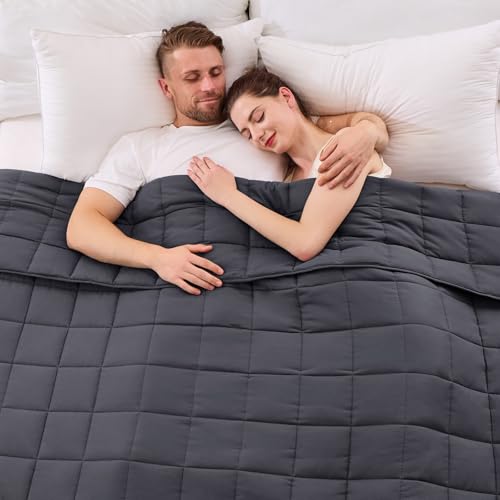
yescool King Size Weighted Blanket for Adults (20 lbs, 80” x 87”, Grey) Cooling Heavy Blanket for Sleeping Perfect for 190-210 lbs, Breathable Blanket for Adults & Couple All Season, Machine Washable
- Recommended Weight: 10% of your body weight
- Size Compatibility: Fits Queen and King beds
- Placement: Fits on top of mattress
As an affiliate, we earn on qualifying purchases.
As an affiliate, we earn on qualifying purchases.
The practical upsides of two individual weighted blankets
Two separate blankets offer a world of flexibility. Each person can pick a weight, size, and fabric that match their preferences perfectly. If one likes a lighter touch while the other craves deep pressure, individual blankets let you tailor that without conflict.
Imagine one partner prefers a 15-pound blanket for a gentle hug, while the other finds 20 pounds more soothing. With separate blankets, both get exactly what they need. Plus, if one partner tends to toss or pull during the night, it won’t disturb the other.
Say goodbye to blanket tug-of-wars or waking up cold because your partner stole the cover. Two blankets can even help with temperature regulation—each can choose breathable, cooling fabrics suited to their comfort.
individual weighted blankets for sleep
As an affiliate, we earn on qualifying purchases.
As an affiliate, we earn on qualifying purchases.
Comparison table: sharing one blanket vs. two individual blankets
| Feature | Shared Blanket | Two Individual Blankets |
|---|---|---|
| Cost | Lower (one blanket) | Higher (two blankets) |
| Flexibility | Limited — compromises needed | High — tailored to each person |
| Ease of washing | More complicated, especially if large | Separate washing, easier to handle |
| Comfort customization | One size fits all — often a compromise | Precisely tailored to each person |
| Movement & disturbance | More likely to transfer motion | Isolates movement, less disturbance |
| Safety & suitability | Risk of discomfort if preferences differ | Safer — each uses what suits them best |
| Appearance & bed setup | Unified look | Potential overlap or mismatch, but more personalized |

ZonLi Duvet Cover for Weighted Blanket
- Soft and Breathable Material: Keeps you comfortable and airflow optimal
- Secure Attachment Ties: 8 ties to prevent shifting of blanket
- Discreet Hidden Zipper: Easy to remove and put on
As an affiliate, we earn on qualifying purchases.
As an affiliate, we earn on qualifying purchases.
Safety first: what to watch out for with weighted blankets
Weighted blankets aren’t suitable for everyone. People with respiratory issues, sleep apnea, circulation problems, or mobility limitations should proceed with caution. If you have any health concerns, chat with a healthcare provider before trying one.
Never use a weighted blanket over the face or on someone who can’t remove it independently. Pets and children should also stay clear—heavy blankets can pose risks like entrapment or breathing issues.
For example, a partner with asthma might find the pressure calming, but if they experience difficulty breathing, it’s time to reconsider. Always prioritize safety and comfort over style or cost.

yescool Weighted Blanket for Adults (20 lbs, 60” x 80”, Grey) Cooling Heavy Blanket for Sleeping Perfect for 190-210 lbs, Queen Size Breathable Blanket with Premium Glass Bead, Machine Washable
- Recommended Weight Range: 7%-10% of your body weight
- Fits on Top of Mattress: Queen size (60”x 80”) fits mattress
- Durable Construction: Tightly stitched with high-density stitches
As an affiliate, we earn on qualifying purchases.
As an affiliate, we earn on qualifying purchases.
How to pick the right weighted blanket for each partner
Choosing the perfect weighted blanket isn’t just about weight. It’s about size, fabric, and how it feels. Here’s a quick step-by-step:
- Start with body weight—aim for 5-10% of your weight, but don’t stress if it feels too heavy or light.
- Consider your sleep preferences—do you like it snug or breathable?
- Choose a size that covers your body without hanging over the edges.
- Pick a fabric that matches your room temperature and comfort—breatheable cotton or bamboo if you tend to overheat.
- Test it out during a trial period. Many brands offer flexible return policies.
For example, if one partner weighs 180 pounds and prefers a gentle pressure, a 15-pound blanket might be perfect. The other, at 130 pounds, might want just 10 pounds.
Temperature and fabric: making sleep cozy, not sweaty
Weighted blankets can trap heat, so choosing breathable fabrics matters. Couples prone to overheating should look for knits, cotton, bamboo, or moisture-wicking covers. Avoid heavy fleece or non-breathable synthetic layers.
For instance, a couple living in a warm climate might opt for a lightweight, open-knit blanket that allows air to circulate. If one partner sleeps colder, a removable, washable cover in a wool blend can add warmth without overheating the other.
Remember, a blanket that feels cozy for one might be stifling for the other. Separate blankets with different fabrics are a smart way to balance warmth and breathability.
Cleaning, maintenance, and longevity — what you need to know
Weighted blankets vary in how easy they are to clean. Larger models might not fit in your home washing machine, making professional cleaning or spot cleaning necessary. Removable covers can simplify maintenance.
For example, a 20-pound blanket might need to be dry-cleaned or washed at a laundromat. In contrast, a smaller, removable cover can be tossed in your regular machine weekly, keeping things fresh and hygienic.
Always follow the care label. Well-made blankets with secure seams and even fill distribution last longer and stay comfortable over time.
Latest trends: what’s changing in couples’ weighted bedding
Manufacturers are now offering more options tailored for couples. Dual-zone models allow different weights on each side, and fabrics are becoming more breathable and temperature-neutral. Modular designs let each partner customize their side.
Interest in separate sleep systems is growing, reflecting a shift toward personalized comfort. Longer trial periods and easier returns help couples find their perfect match without risk.
For example, some brands now sell queen-sized blankets with adjustable zones, so one side can be 15 pounds while the other is 20. It’s all about personal comfort, not just tradition.
Making the call: shared or separate blankets?
If both partners share similar sleep habits, temperatures, and pressure preferences, a well-chosen shared blanket can work. Just make sure it’s not too heavy or too light for either of you. It simplifies bedding and can save money.
But if there are differences in size, warmth, or comfort preferences, two individual blankets usually win. They give each person control and reduce frustration or discomfort. Starting with one individual blanket on trial can help you decide without a big commitment.
Think of it this way: a couple who loves the same temperature and pressure might enjoy a large, shared blanket. But for most, separate blankets are the smarter, safer choice.
Frequently Asked Questions
Can couples safely share a weighted blanket?
Yes, if both partners can move freely, breathe comfortably, and don’t have conditions that make weighted bedding unsafe. Safety and comfort should always come first, so if either partner feels restricted or uncomfortable, consider separate blankets.
What weight should a couples weighted blanket be?
There’s no one-size-fits-all number. Instead, choose a blanket designed for two adults—generally around 15-20 pounds—and prioritize individual comfort. Avoid adding weights together or relying solely on the 10% rule.
Should we add 10% of each partner’s body weight together?
No. Combining weights can produce an overly heavy blanket. It’s better to select separate blankets that match each person’s preference, ensuring comfort and safety for both.
Is one king-size weighted blanket better than two twin-size blankets?
A king-size offers a unified look and shared coverage, but two smaller blankets provide more control and less tugging. Choose based on your sleep habits and whether you prefer individual comfort or shared experience.
What if one partner is much heavier than the other?
Separate blankets are usually best. Each can select the weight and size that feels right, avoiding discomfort or safety concerns caused by a blanket that’s too heavy or too light for either person.
Conclusion
Your best sleep setup depends on your unique needs. Whether you opt for one shared blanket or two separate ones, the goal is comfort, safety, and a peaceful night. Remember: good sleep isn’t about fitting into a mold — it’s about creating the space where you rest best. So, choose what feels right, and don’t be afraid to adjust until your nights are truly restful.Back to school Picks
back to school
As an affiliate, we earn on qualifying purchases.