TL;DR

Get wellness gear delivered free with Prime
- Fast, free delivery on millions of items
- Prime Video, Amazon Music and more included
- Member-only deals all year
A Fit&Well report says heels lifting during a squat can reflect limited ankle movement, but may also relate to hip mobility or strength. It recommends three supported squat variations that let people practice range and control gradually; the report does not establish a diagnosis or guarantee a fix.
A Fit&Well report on squat technique says heels lifting during a squat may be associated with limited ankle dorsiflexion or, for some people, hip mobility or strength limitations. It recommends three scaled squat exercises—using suspension straps, a chair or heel supports—to help people practice depth and control, while stressing gradual progress rather than a guaranteed correction.
The report describes limited ankle dorsiflexion as one common explanation: if the calves or ankle joints restrict the shin from moving forward over the foot, a person may struggle to descend while keeping the whole foot grounded. But it cautions against assuming that the ankles are always the cause. In some cases, the report says, lifting the heels may be a protective response connected to weak or tight hips. It argues that ankle and calf stretches alone may not address that pattern.
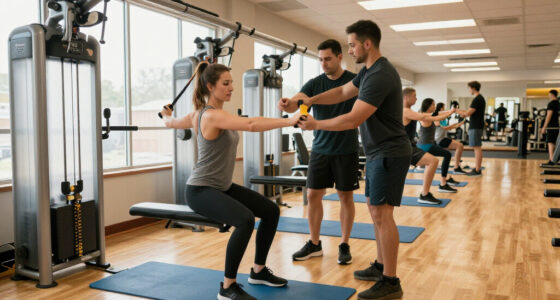
Its first suggested variation is a suspension-trainer squat. Holding the straps provides support and reduces the balance challenge, allowing the person to practice a deeper position. The second is a slow sit-to-stand from a sturdy chair: the exerciser stands without pushing off with the hands, then lowers slowly to build control. The third is a heel-elevated deep squat hold, using thin plates or wedges under the heels to make a deep position more accessible.
For all three, Fit&Well advises exploring a manageable range and improving gradually before focusing on volume. Once comfortable with the technique, its suggested session is three sets of each movement, working for one minute and resting for one minute. For the heel-supported hold, the proposed progression is to reduce the support height over time, with the eventual aim of squatting with the heels on the floor. These are the report’s exercise recommendations, not individualized medical advice.
What Heel Lift Can Signal
Knowing that more than one factor may be involved can help people avoid treating every heel lift as a simple calf-tightness problem. The report’s distinction matters because a single stretch routine may not address limitations in hip mobility or strength, while supported variations offer a way to practice the movement with less demand on balance or depth at the outset.
The exercises also frame progress as a matter of control and gradual range, not forcing the heels down at any cost. That may make the guidance more accessible to people who find a bodyweight squat difficult. However, the report does not supply clinical testing or evidence that these movements resolve the cause for every person, so persistent discomfort or concern calls for advice from a qualified health professional.
Products Worth Considering

DEWALT 20V MAX 1/4-Inch Impact Driver Kit with Battery and Charger (DCF787D1)

EGO Power+ 3-Gallon Compact Cordless Wet/Dry Vacuum, 85 CFM (WDV0300)

EGO Power+ Cordless Pole Saw with LED Cut Line Indicator, 56V 2.5Ah Battery and Charger (PS1001)
As an affiliate, we earn on qualifying purchases.
Why Squat Depth Varies
A squat requires the ankles, knees and hips to move together while the person maintains balance. The Fit&Well article focuses on the moment the heels rise during descent, describing ankle movement as a frequent explanation while also noting that hip limitations can play a role for some people. Its author says the issue affected them when they began strength training and that they had seen it among clients, but those observations are personal experience rather than a formal assessment of prevalence.
The proposed sequence moves from greater support toward less: straps assist the squat, a chair gives a clear target for controlled standing and sitting, and heel supports allow practice at depth. The report presents repetition over several weeks as a way to build familiarity and strength, but does not provide research findings, a standard timeline, or an assessment method for identifying which limitation applies to an individual.
“For some, however, especially those with particularly weak or tight hips, the heels lifting could actually be a protective mechanism to safeguard the body from injury.”
— Fit&Well report
The Cause May Differ
The report does not establish why a particular person’s heels lift. It gives possible links to ankle dorsiflexion and hip mobility or strength, but does not describe a clinical examination or provide a way to distinguish between them. It is also unclear from the supplied material whether the three exercises have been tested in a study or how often they lead to the stated outcome.
No specific timeframe for improvement is promised. The report refers to regular practice over a few weeks, but individual progress may differ. It does not set out how to respond to pain, injury, or symptoms that worsen during exercise; readers with those concerns should seek guidance from a qualified professional rather than push through them.
How the Exercises Progress
The report’s next step is regular, comfortable practice, beginning with a range the person can control. It advises first learning each variation, then working toward three one-minute sets with a minute of rest between sets once technique feels confident. For suspension squats, progress means relying less on the straps; for sit-to-stands, it means slowing the descent; for heel-elevated holds, it means gradually lowering the heel support.
The guidance does not specify a follow-up assessment or a fixed date by which heels should remain down. If the movement remains uncomfortable, the cause is uncertain, or symptoms arise, an individualized assessment from a qualified health or fitness professional can help determine an appropriate next step.
Key Questions
Why do my heels come up when I squat?
The Fit&Well report says one possible reason is limited ankle dorsiflexion, which can be associated with tight calves or restricted ankle joints. It also says hip mobility or strength may contribute for some people. The cause cannot be identified from heel lift alone.
Will stretching my calves fix the problem?
Not necessarily. The report says ankle and calf stretches may not address the issue if hip mobility or strength is involved. It recommends supported squat variations, but does not claim they will fix every case.
What are the three exercises in the report?
They are a suspension-trainer squat, a slow sit-to-stand from a sturdy chair, and a heel-elevated deep squat hold using plates or wedges. The report presents them as gradual practice variations.
How often should I do these exercises?
The report suggests first practicing each version and improving gradually. When technique feels confident, it proposes three sets of each movement, working for one minute and resting for one minute. That is the article’s guidance, not a personalized prescription.
Should I keep exercising if squatting hurts?
The supplied report does not give a pain-management protocol. If you have pain, an injury, or symptoms that worsen, do not treat the exercises as a diagnosis or push through; seek advice from a qualified health professional.
Source: fitandwell.com