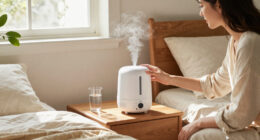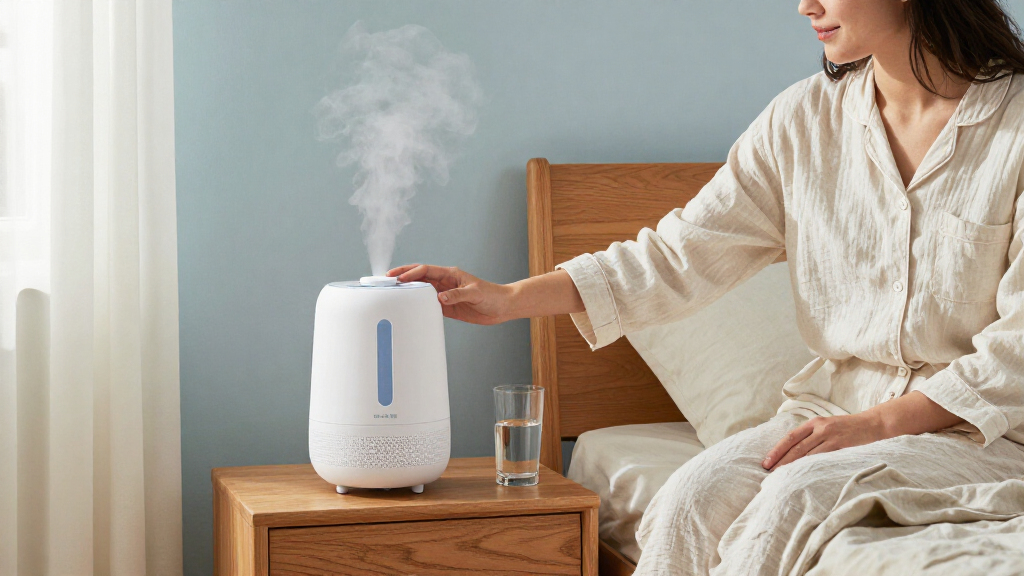

Choosing a bedside humidifier is less about finding the most powerful machine than deciding what kind of moisture, upkeep, and safety tradeoffs fit your room. Cool-mist humidifiers release moisture without heating the water; warm-mist models heat water to produce steam. Both can raise indoor humidity, but neither should be expected to treat the cause of a cough, congestion, or dry skin.

Get wellness gear delivered free with Prime
- Fast, free delivery on millions of items
- Prime Video, Amazon Music and more included
- Member-only deals all year

DREO Smart Humidifiers for Bedroom, 4L Cool Mist Humidifier
- ✔ Capacity: 4 liters
- ✔ Maximum stated runtime: Up to 36 hours
- ✔ Specified floor area: 300 square feet

BLUEAIR 2.1L Mist-Free Humidifiers for Home, 1/2 Gallon, DreamWell Beige
- ✔ Capacity: 2.1 liters
- ✔ Operation: Evaporative, mist-free
- ✔ Specified floor area: 370 square feet

DREO 4L Humidifiers for Bedroom, 36H Runtime, 28 dB Quiet, HM311
- ✔ Capacity: 4 liters
- ✔ Maximum stated runtime: Up to 36 hours
- ✔ Specified floor area: 300 square feet
For most bedrooms, cool mist is the more practical starting point: it avoids a hot-water reservoir and suits rooms where children or pets may be nearby. Warm mist may appeal to adults who prefer its heated output, especially in a cool room, but it calls for more care around the unit. The differences in room comfort and maintenance depend heavily on the specific model, so use the comparison below to choose by routine and placement rather than mist appearance alone.
At a Glance
| Criteria | Cool-mist humidifiers | Warm-mist humidifiers | Winner |
|---|---|---|---|
| Bedroom safety | No boiling water or hot steam; easier to place around children, though spills and electrical cords still need care | Heated water and steam can burn; requires stable, out-of-reach placement | A |
| Comfort and output | Room-temperature mist; may feel cooling and does not warm the room | Warm steam may feel pleasant in a cool room but does not materially heat a bedroom | Depends |
| Noise | Evaporative units can use a fan; ultrasonic units are often quiet, with model-specific variation | Often quiet because many models do not need a fan; boiling sounds vary | Depends |
| Cleaning and upkeep | Mineral deposits and standing water need regular cleaning; some models can disperse minerals as white dust | Requires descaling and careful handling of hot water; cleaning frequency depends on water and use | Depends |
| Room suitability | Flexible for most bedrooms and warmer climates | Best for adult bedrooms with secure placement and a preference for warm output | A |
| Running costs | Often low energy use, especially ultrasonic models; filter replacement may add cost | Heating water generally uses more electricity; filter needs vary by design | A |
| Value | Best general-purpose fit when safe placement and low energy use matter | Worth paying for only when warm output is a specific preference | A |
DREO Smart Humidifiers for Bedroom, 4L Cool Mist Humidifier
The DREO Smart 4L earns our top spot by pairing the kind of overnight capacity many bedroom buyers want with more ways to manage humidity. Its 4-liter tank is listed for up to 36 hours of operation, and the manufacturer specifies coverage for rooms up to 300 square feet. That combination makes it more suitable for a full bedroom than a personal-space humidifier, though its footprint means it needs a stable spot near the bed rather than a crowded nightstand.What sets it apart from the HM311 is connectivity: this model adds app and voice control, along with automatic humidity adjustment. Those features can make bedtime changes easier when reaching the unit is inconvenient. The tradeoff is that buyers who prefer a basic appliance may find the connected controls unnecessary. Like the HM311, it uses ultrasonic cool mist and advertises a quiet 28 dB operation, so the Smart model’s main distinction is how much control it offers, not a different mist method.DREO describes its mist as fine and evenly dispersed, and optional cartridges are available for mineral-related white dust and other maintenance needs. Those cartridges are an added consideration for upkeep, and the product’s stated runtime is a maximum rather than a guarantee for every setting. We’d choose it for a bedroom where room-wide coverage and remote adjustment matter more than keeping the setup especially compact or simple.
Pros:
- 4-liter tank with up to 36-hour stated runtime
- App, touch, and voice control options
- Automatic humidity adjustment and room-condition lighting
- Specified for rooms up to 300 square feet
Cons:
- Larger footprint than the bedside-focused BLUEAIR
- Ultrasonic mist may call for attention to water mineral content and nearby surfaces
- Optional cartridges add another maintenance consideration
Best for: Bedroom owners who want a large tank, automatic humidity adjustment, and app or voice controls.
Not ideal for: Anyone seeking a very compact nightstand unit, a mist-free evaporative design, or controls without connected features.
Bottom line: We recommend the DREO Smart 4L for bedrooms where overnight capacity and flexible humidity control outweigh a compact, minimal setup.
“We recommend the DREO Smart 4L for bedrooms where overnight capacity and flexible humidity control outweigh a compact, minimal setup.”
BLUEAIR 2.1L Mist-Free Humidifiers for Home, 1/2 Gallon, DreamWell Beige
The BLUEAIR DreamWell takes a different route from both DREO models. It uses evaporative 360° InvisibleMist technology to release humidity without a visible mist, which may appeal to bedroom buyers who would rather avoid a visible plume near furniture or bedding. Its 2.1-liter capacity and compact positioning suit personal spaces, nurseries, and nightstands better than the DREO units’ larger-room emphasis.Its bedside case also rests on a notably practical care routine: the tank is described as dishwasher-safe, and it can be refilled by pouring water into the top or using a bucket-fill method. The durable PET wick is stated to last up to six months, though it is still a replaceable component to track. Compared with the DREO models’ 4-liter tanks and up-to-36-hour runtimes, the BLUEAIR has less water capacity, so buyers should consider how often they want to refill it.The Smart Auto Mode helps reduce manual adjustment, but the product specifically has no Wi-Fi or app connectivity. That makes it less flexible than the DREO Smart, while keeping the controls more focused. Aroma diffusion is included for a bedtime routine, but the central reason to choose this model is its mist-free evaporative format and bedside-friendly maintenance. Skip it if you want connected control or the largest tank in this lineup.
Pros:
- Evaporative operation releases humidity without visible mist
- Compact format is positioned for nightstands and personal spaces
- Dishwasher-safe BPA-free tank with two refill methods
- Auto mode and integrated aroma diffusion
Cons:
- Smaller 2.1-liter capacity than either DREO model
- No Wi-Fi or app connectivity
- Uses a wick that must be replaced over time
Best for: Sleepers who want a compact evaporative humidifier with automatic mode and an easy-to-clean tank.
Not ideal for: Buyers who want app or voice control, a 4-liter reservoir, or a stated long runtime between refills.
Bottom line: We’d pick the BLUEAIR DreamWell when mist-free bedside operation and a convenient cleaning routine matter more than a large tank or connected controls.
“We’d pick the BLUEAIR DreamWell when mist-free bedside operation and a convenient cleaning routine matter more than a large tank or connected controls.”
DREO 4L Humidifiers for Bedroom, 36H Runtime, 28 dB Quiet, HM311
The DREO HM311 gives bedroom buyers the same broad capacity appeal as the Smart 4L: a 4-liter tank, an advertised runtime of up to 36 hours, and stated coverage for rooms up to 300 square feet. Its ultrasonic cool mist and claimed 28 dB operation also make it a plausible choice for overnight use. The top-fill design is a useful detail beside a bed because it avoids having to turn a filled tank upside down to refill it.Compared with the Smart model, the HM311 keeps operation more straightforward. Its listed controls are touch-based, and it does not advertise that model’s app or voice access. That is a real advantage if we want fewer connected features to manage, but a drawback if we expect to change settings remotely or rely on voice commands. It also differs from the BLUEAIR: the HM311 has a much larger tank, while the BLUEAIR’s evaporative system avoids a visible mist.The HM311 includes an ambient light and aroma-diffuser feature, but essential oils are not included. Its larger capacity is useful when refills are a nuisance, yet it remains a floor or side-table appliance rather than the most compact nightstand pick in this lineup. Choose it for simple touch control and long stated runtime; choose the Smart 4L if connected adjustment is worth the extra complexity.
Pros:
- 4-liter capacity and up to 36-hour stated runtime
- Top-fill design and removable modular parts
- Specified for rooms up to 300 square feet
- Touch controls, night light, and aroma-diffuser feature
Cons:
- No app or voice control is listed
- Ultrasonic visible-mist approach differs from the BLUEAIR’s mist-free design
- Essential oils for the aroma feature are not included
Best for: Buyers who want a large ultrasonic humidifier with top filling, touch controls, and a long stated runtime.
Not ideal for: People who need app or voice control, prefer mist-free operation, or have very limited bedside space.
Bottom line: We recommend the HM311 for buyers who want the DREO Smart’s basic large-tank bedroom format without its app and voice-control emphasis.
“We recommend the HM311 for buyers who want the DREO Smart’s basic large-tank bedroom format without its app and voice-control emphasis.”
As an Amazon Associate we earn from qualifying purchases.
Key Differences
The largest practical difference is heat. Cool-mist models avoid boiling water, so they are easier to position in family bedrooms and do not add warmth to an already comfortable room. Warm-mist units create heated steam, which some adults find soothing in a cool bedroom. The output itself does not make one type a proven treatment for illness, and warmth should not be confused with meaningful room heating.
Upkeep can outweigh the mist preference. Both types need frequent water changes and regular cleaning to limit microbial growth and mineral scale. Warm-mist reservoirs need care because water is heated and the unit may remain hot; cool-mist models can produce mineral residue in the room, particularly when ultrasonic units use hard water. A model with accessible parts, a simple tank, and clear cleaning instructions is often easier to live with than one chosen by mist type alone.
For most buyers, cool mist offers the better blend of placement flexibility, safety, and energy use. Warm mist is a reasonable choice for an adult who specifically prefers heated output, has a secure bedside surface, and accepts extra caution around hot components. In either case, use a hygrometer if possible and avoid over-humidifying: persistent condensation or damp surfaces signal that the output should be reduced.
Detailed Comparison
Bedroom safety (Cool-mist humidifiers wins — major)
Cool mist wins by a major margin for rooms accessible to children or pets because it does not boil water or emit hot steam. It still needs a stable surface, cord management, and sensible placement away from bedding. Warm mist introduces burn risks from the steam and heated water, so it is best kept well out of reach and away from a bed edge.
Comfort and output (moderate difference)
This is preference-led, so the winner depends on the room and user. Cool mist adds moisture without warming the immediate area and may feel cooler. Warm mist offers heated output that can feel pleasant in a chilly room. The difference is moderate for comfort, but neither type should be treated as a substitute for medical care or a heater.
Noise (minor difference)
There is no universal winner. Ultrasonic cool-mist units are often quiet, while evaporative models use a fan that can be audible. Warm-mist units can avoid fan noise but may make bubbling or boiling sounds. For light sleepers, check the noise specification and reviews for the exact model; the mechanism alone does not settle it.
Cleaning and upkeep (moderate difference)
The gap is minor and model-dependent because both types require routine tank cleaning, fresh water, and scale removal. Warm-mist models add caution when handling hot water and may need descaling. Cool-mist ultrasonic models can leave mineral dust when used with mineral-rich water; distilled or appropriately filtered water may reduce deposits, though it adds recurring expense.
Room suitability (Cool-mist humidifiers wins — moderate)
Cool mist is the more flexible choice, a moderate win for bedrooms shared with children, pets, or varied room temperatures. It does not add heat and is easier to place. Warm mist is a better match for an adult bedroom where warm output is wanted and the device can sit securely away from contact.
Running costs (Cool-mist humidifiers wins — moderate)
Cool mist usually wins, though the size of the savings depends on the model and how long it runs. Ultrasonic units tend to use little electricity, while warm-mist units consume more to heat water. Filter replacements, water choice, and cleaning supplies can also affect total ownership cost, so compare those before buying.
Value (Cool-mist humidifiers wins — moderate)
Cool mist is the stronger value for most households because it meets the general goal of adding bedroom humidity with fewer placement constraints and often lower energy use. Pay more for warm mist only if heated output is a real comfort preference and the bedroom setup makes safe use straightforward. A humidistat and easy-to-clean design can matter more than mist temperature.
Cool-mist humidifiers: Pros and Cons
Pros:
- No hot steam or boiling-water burn hazard
- Fits a wider range of bedroom layouts and household situations
- Ultrasonic versions are often quiet and energy-efficient
Cons:
- Does not provide heated output
- Some fan-based models can be audible
- Ultrasonic models may disperse mineral dust with hard water
Warm-mist humidifiers: Pros and Cons
Pros:
- Heated steam can feel pleasant in a cool bedroom
- Many models operate without a fan
- Avoids the cool sensation some people dislike
Cons:
- Hot water and steam raise burn risk
- Uses more electricity to heat water
- Needs careful placement and handling, plus routine scale removal
Who Should Choose What
Choose Cool-mist humidifiers if:
- You want a low-risk default for a bedroom shared with children or pets.
- You prefer moisture without added warmth or want lower energy use.
- You are considering an ultrasonic model and can keep up with cleaning and mineral control.
Choose Warm-mist humidifiers if:
- You are an adult who specifically prefers warm output in a cool bedroom.
- You can place the unit securely where hot steam and water are out of reach.
- You are willing to accept higher electricity use and more careful handling for that comfort preference.
Skip both if: Skip both if you cannot clean a water reservoir regularly, if the room already has condensation or dampness, or if you need treatment for persistent breathing symptoms rather than added humidity.
Value for Money
For most buyers, paying extra for warm mist is not worthwhile unless heated output is the reason for choosing it. Its warmth is a comfort feature, not a meaningful way to heat a bedroom, and it brings higher power use and burn precautions. A reasonably priced cool-mist model with a tank sized for the room, automatic shutoff, and parts that are easy to clean is usually the better value. Spend more when a useful feature, such as a humidistat or quieter operation, solves a real need; do not pay a premium for mist temperature alone.
Final Verdict
Choose cool mist as the default for a bedside humidifier. It suits more bedrooms, avoids heated water, and usually costs less to run. Choose warm mist when you are an adult who clearly prefers warm output, has a secure place for the unit, and accepts the extra energy use and burn precautions. The biggest deciding factor is whether that heated sensation matters enough to justify those tradeoffs. If it does not, cool mist is the more sensible buy.
Frequently Asked Questions
Is cool mist or warm mist better for a bedroom?
Cool mist is the better general-purpose choice because it avoids hot water and suits more room setups. Warm mist may be preferable for an adult who wants heated output and can place the unit safely. Neither is automatically better for health.
Can a warm-mist humidifier heat the bedroom?
It adds some warmth near the steam, but it is not a substitute for a room heater. Choose it for the feel of its output, not to warm the whole bedroom.
Which type is quieter for sleeping?
It depends on the model. Ultrasonic cool-mist units are often quiet, while evaporative models use a fan; warm-mist units may make bubbling sounds. Check noise details for the specific product.
How do I prevent a humidifier from making the room too damp?
Use a hygrometer to monitor humidity, follow the unit’s room-size guidance, and lower or stop output if condensation appears on windows or walls. Clean and dry the unit as directed between uses.