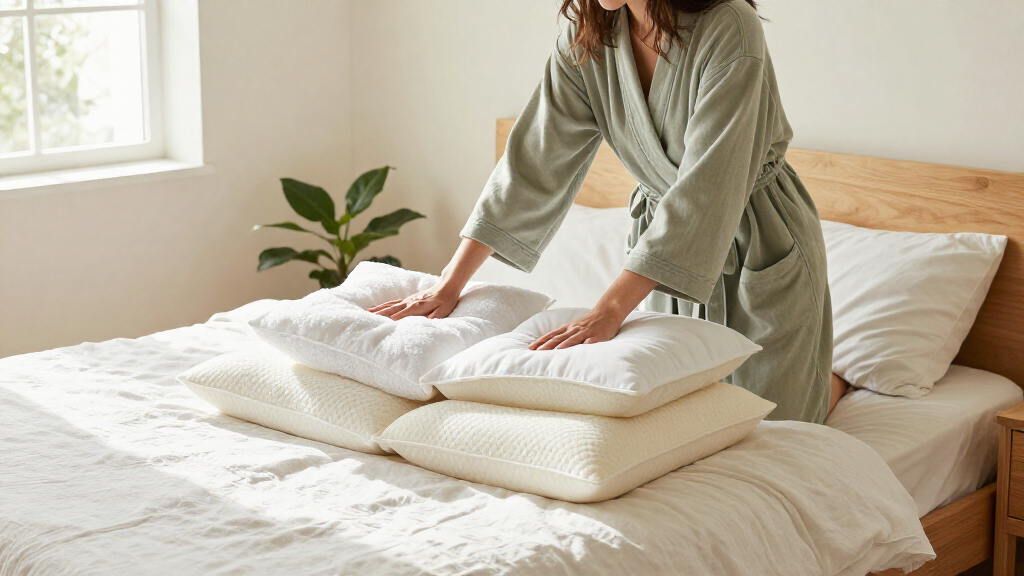

TL;DR

Get wellness gear delivered free with Prime
- Fast, free delivery on millions of items
- Prime Video, Amazon Music and more included
- Member-only deals all year
Down feels soft and easy to reshape, down-alternative offers a synthetic fiber option, foam can contour or adjust depending on its construction, and latex tends to feel buoyant. No fill works best for everyone: choose a comfortable loft and firmness for how you sleep, then check warmth, care instructions, materials, and sensitivities.
A pillow can feel cloud-soft in your hands and still leave your head perched too high at 2 a.m. That’s because fill is only part of the fit: loft, firmness, your sleep position, and how much the pillow compresses all shape your comfort.
This pillow fill guide compares down, down-alternative, foam, and latex in everyday terms. You’ll learn how each tends to feel, what to expect from warmth and care, and how to narrow your choice without treating any material as a universal answer.
Think of fill like the suspension on a bicycle: it changes the ride, but the frame and the road still matter. Your shoulders, mattress, room temperature, and habit of rolling from side to back all influence how a pillow feels through the night.
Down is soft and moldable; down-alternative is usually synthetic fiber; foam ranges from close-contouring to adjustable; latex often feels resilient.
Choose loft and firmness alongside fill: side sleepers often start higher, back sleepers medium, and stomach sleepers low and soft.
Warmth depends on the cover, fill density, room, and full design, so a “cooling” label does not guarantee a cool feel.
Check care instructions before buying: many foam and latex cores should not be machine-washed, even when their covers are washable.
Treat “hypoallergenic” as a broad marketing term, and follow clinician advice for diagnosed allergies.
The Rest Edit / Pillow Fill Guide
Down, Fiber, Foam & Latex
Fill changes the feel, but fit shapes the night. Compare how common pillow materials compress, reshape, retain warmth, and need care—then choose loft and firmness around the way you sleep.
Four materials, four different rides
Think of fill like a bicycle’s suspension: it changes the ride, while the frame and road still matter. A label is a useful clue, but construction determines how the pillow behaves once you settle in.
Down
Light, soft, compressible, and easy to fluff or mold. It can retain warmth and may need careful laundering.
Down-alternative
Usually polyester fiber, spanning plush to firm. Often easier to wash, though warmth and durability vary.
Foam
Solid memory foam contours closely; shredded foam can be adjusted and reshaped. Some designs retain heat.
Latex
Often resilient and buoyant, with less sinking than memory foam. Composition may be natural, synthetic, or blended.
Ask the useful questions
These are broad patterns, not guarantees. Price, durability, comfort, and care can vary from one product to another—even within the same fill family.
Material snapshot / read the specific product label
| Fill | Common feel | Warmth & care | What to check |
|---|---|---|---|
| Down | Light, soft, compressible; easy to fluff | May retain warmth; careful laundering or professional cleaning may be needed | Down, feathers, or blend; sourcing details |
| Down-alternative | Polyester fiber; plush, medium, or firm | Often easier to wash; breathability and warmth vary | Fiber quality, wash directions, and allergy claims |
| Foam | Solid core contours; shredded fill can be reshaped | Some designs hold heat; many cores cannot be machine-washed | Core type, ventilation, removable cover, temporary odor |
| Latex | Often springy and buoyant | Generally holds shape; care depends on construction | Natural, synthetic, or blended latex; possible sensitivity |
A “cooling” label does not guarantee a cool feel. Cover fabric, weave, fill density, room conditions, and the pillow’s full design all contribute to warmth.
Start with how you sleep
Loft is the pillow’s height under your head. Position offers a starting point, then shoulder width, body shape, mattress firmness, and personal comfort fine-tune the fit.
Side
Often starts with higher loft to fill the space between shoulder and head.
Back
Often suits medium loft that supports the neck without pushing the head forward.
Stomach
Often favors a low, soft pillow; some sleepers prefer none under the head.
Combination
May value reshaping or adjustable fill while moving between positions.
Comfort cue: If you keep folding, bunching, or flattening your pillow, its loft or firmness may not suit you. A home trial reveals more than a quick squeeze in a shop.
Reshape, contour, or spring back?
A qualitative snapshot of common tendencies—not a lab score. Fill design changes the result: adjustable shredded foam can feel unlike a solid block, and fiber pillows vary widely.
Soft and moldable; may puff back after a fluff.
Fiber quality and density shape the feel and resilience.
Solid foam contours; shredded fill may be adjusted.
Often pushes back quickly and feels resilient.
Bars illustrate relative, commonly described tendencies for reshape or response; they are editorial cues, not measured ratings.
Narrow your choice, one question at a time
Start with your sleep position, then account for the way a pillow feels and fits in your real bedroom and laundry routine.
Position
Side, back, stomach, or a mix through the night?
Loft & firmness
Choose a height and support that feel comfortable after compression.
Preferred feel
Soft and moldable, close-contouring, adjustable, or buoyant?
Warmth
Check cover, weave, density, ventilation, and room conditions.
Care & materials
Read wash directions, composition, and sensitivity details.
Make the details work for your routine
Compare the whole pillow: construction, cover, care label, and claims. These practical details can matter as much as the material name.
Washability
Check whether the entire pillow or only its cover can be washed. Many foam and latex cores should stay dry. A protector can help keep bedding clean.
Sensitivities
Dust mites can collect in bedding of many types. Washable covers and allergen-proof encasements may help; follow clinician advice for diagnosed allergies.
Claims & lifespan
“Hypoallergenic” is not a guarantee. Check what a certification actually covers. Replace a pillow when it loses comfortable support, has persistent odors, or cannot be cleaned as directed.
Before you buy: Confirm fill composition, adjustability or removable layers, cover materials, and full washing instructions. “Cloud-like” and “cooling” do not explain how a pillow will feel once your head settles in.
Fit is a whole-night equation
No fill works best for everyone. A comfortable choice balances your position, body, preferred feel, and everyday care needs.
Shoulders & shape
Mattress firmness
Position & movement
Temperature & routine
Loft + feel + care
Know what each pillow fill feels like before you choose
A pillow fill is the material inside the cover, and it shapes how the pillow compresses, springs back, and holds warmth. Down is light and moldable; down-alternative is usually polyester fiber; foam ranges from close-contouring blocks to reshaped shreds; latex often feels springy and buoyant. Those are broad patterns, not guarantees.
Imagine squeezing four pillows at a store. Down may puff back after a quick fluff, fiber may feel plush or dense depending on its construction, solid memory foam may slowly follow the shape of your hand, and latex may push back more quickly. The label starts the conversation; it doesn’t finish it.
That’s why a pillow fill guide should include construction details. A shredded-foam pillow that lets you remove filling can feel very different from a solid foam core. A “latex” label may mean natural, synthetic, or blended material, so check the product details instead of assuming every latex pillow has the same composition or feel.
The fill affects more than softness. It can change how easily you reshape the pillow, how much warmth you notice, and which cleaning instructions apply. For instance, a shift worker who naps at varied times might value a pillow that’s easy to fluff, while someone who dislikes a sinking feel may prefer a more resilient material.
In practice, compare a few specific details: fill composition, whether the height is adjustable, the cover fabric, and the care label. These are more useful than a broad claim like “cloud-like” or “cooling,” which doesn’t tell you how the pillow will feel after your head settles in.
Products Worth Considering

DEWALT Brad Nailer Kit, 18GA, 5/8-Inch to 2-Inch, Pneumatic (DWFP12231)

DEWALT DW074KD Indoor/Outdoor Self-Leveling Rotary Laser Level Kit

DEWALT DCD771C2 20V MAX Cordless Compact Drill/Driver Kit
As an affiliate, we earn on qualifying purchases.
Compare down, fiber, foam, and latex in one quick table
Down, down-alternative, foam, and latex each trade one kind of feel or convenience for another. Down often feels soft and easy to mold, down-alternative covers a wide range of synthetic fiber feels, foam can contour or be adjusted, and latex usually feels buoyant. Use the table as a starting point, then check the exact construction and care directions.
| Fill | Common feel | Warmth and care | What to check |
|---|---|---|---|
| Down | Light, soft, compressible, easy to fluff | May retain warmth; may need careful laundering or professional cleaning | Whether it contains down, feathers, or a blend; sourcing details |
| Down-alternative | Polyester fiber; may feel plush, medium, or firm | Often easier to wash, but warmth and breathability vary | Fiber quality, wash directions, and what “hypoallergenic” means on the label |
| Foam | Solid foam contours closely; shredded foam can be reshaped | Some designs hold heat; many cores cannot go in a washing machine | Core type, ventilation, removable cover, and any temporary new-foam odor |
| Latex | Often resilient and buoyant, with less sinking than memory foam | Typically holds its shape; care varies by construction | Natural, synthetic, or blended latex; possible latex sensitivity |
Take a reader with a warm bedroom and a preference for easy washing. A washable fiber pillow may appeal, but it could still feel warm if the cover and fill are dense. A foam pillow marketed as cooling could feel different again; the cover, ventilation, fill density, and room all play a part.
Care can shift the balance too. A down pillow may call for more careful laundering, while a foam pillow may have a removable washable cover and a core that must stay dry. Neither is automatically easier for every household. If you share laundry with children’s bedding or need to wash often, read the full instructions before buying.
Price, durability, and comfort vary by product, even within one material family. Don’t assume all down is luxurious, all foam is firm, or all fiber is easy to wash. The table helps you focus your questions; the specific label gives you the answers that matter for that pillow.
Match the pillow’s height to how you sleep
Sleep position gives you a useful starting point for loft, the pillow’s height under your head. Side sleepers often need more height to fill the space between shoulder and head, back sleepers commonly prefer medium loft, and stomach sleepers often favor a low, soft pillow. Your body shape and mattress can change that starting point.
Suppose you sleep on your side with broad shoulders and a mattress that doesn’t let your shoulder sink much. A very flat pillow may leave a gap, while a loftier one may feel more comfortable. Someone with narrower shoulders or a softer mattress may need less height to reach a similar feeling.
For back sleeping, look for a pillow that feels supportive without pushing your head forward. If you wake and find yourself folding a pillow in half, that may be a clue that its loft or firmness doesn’t suit you. Stomach sleepers often prefer the opposite: a low, soft pillow can reduce how much the head tips back, and some prefer no pillow under the head.
Combination sleepers may change from side to back several times in a night. They might appreciate a pillow they can reshape, such as down, some fiber fills, or adjustable shredded foam. A fixed shape can still work, but it may be less forgiving when you roll over and want a different height.
Use these as comfort cues rather than rules. Your mattress firmness, shoulder width, body shape, and personal preference all affect what feels right. A trial at home can tell you more than a brief squeeze in a shop: notice whether you can settle into a comfortable position without repeatedly bunching or flattening the pillow.
Choose warmth, care, and sensitivity features that fit your routine
Warmth and maintenance depend on the whole pillow, including its cover, weave, fill density, room conditions, and care instructions. Foam may retain heat in some designs, but fiber, down, and latex can also feel warm. A “cooling” label alone cannot promise that a pillow will feel cool to you.
For example, if you read in bed before sleep and keep your bedroom warm, a dense pillow with a thick cover may feel stuffier than a more breathable design. Look for clear details about the cover and construction, and check whether the seller explains the cooling feature beyond a name or color on the packaging.
Care is part of comfort because a pillow is easier to keep fresh when you can follow its washing instructions. Some fiber pillows are designed to be washed; many foam or latex cores should not go in a machine, though a removable cover may be washable. A pillow protector can help keep everyday dust and spills off the cover, as long as you wash it according to its label.
People with sensitivities should read ingredient and material details carefully. “Hypoallergenic” is a broad marketing term, not a promise that nobody will react. Feather or down sensitivity differs from sensitivity to dust mites, which can affect many types of bedding. If you have diagnosed allergies, follow your clinician’s advice; protective encasements and regular washing may help reduce exposure for some people.
Certifications have limits, too. A certification may cover a material or emissions standard without evaluating comfort, durability, or allergy risk. If your household includes a child, an older adult, or a hard-of-hearing sleeper who naps at unusual hours, choose care instructions and materials that fit the actual routine rather than relying on a single label.
Use this five-step check to narrow your pillow choice
You can narrow the field in five steps: start with your sleep position, then consider loft, preferred feel, warmth, and care. This simple check keeps you from choosing by material name alone. Think of it as adjusting a desk chair: you make a few small changes until the fit feels natural.
- Start with your usual position. Side sleepers often begin with more loft, back sleepers with medium loft, and stomach sleepers with low loft.
- Factor in your shoulders and mattress. A broad shoulder or firmer mattress may change how much height feels comfortable.
- Pick the feel you like. Choose between soft and moldable, fiber-plush, close-contouring, or buoyant and springy.
- Check warmth and reshaping. If you run warm or move often, review the full construction and whether you can fluff or adjust the fill.
- Read care and material details. Confirm what can be washed, what needs a cover, and whether the composition fits your preferences.
Here’s how that might work for Maya, who sleeps mostly on her side, changes to her back near morning, and dislikes a deep sinking feel. She could first seek enough loft for her side, then compare resilient latex or adjustable shredded foam. If either feels too tall on her back, she can keep narrowing by looking for removable layers or a shape that compresses comfortably.
Now consider Lee, who sleeps on their stomach and prefers a soft, washable pillow. A low-profile down-alternative option might suit their preferences, but they should still check how the pillow handles washing and whether the advertised height stays low once compressed. Two people can choose different fills and both make a sound choice.
Use a return or trial policy as part of your decision when one is available. It gives you time to notice how the pillow feels through your usual sleep positions. Keep the care label and packaging details until you know the fit works for your routine.
Treat new pillow features as clues, not guarantees
New features can change a pillow’s feel, but the details matter more than the headline. Adjustable shredded foam, removable height layers, and mixed-material designs give you more ways to tailor a pillow. Cooling fabrics, gel infusions, recycled fibers, and plant-based materials may appeal for different reasons, yet performance varies from one construction to another.
Imagine two pillows that both say “cooling.” One may use a smooth cover that feels cool when you first touch it; another may combine a ventilated foam core with a different fabric. That first touch is useful, but it doesn’t tell you exactly how the pillow will feel after your head has rested on it for several hours in a warm room.
Adjustability can be especially helpful if you’re unsure about loft. Some shredded-foam designs let you remove filling, while some pillows use removable layers to change height. That gives you options if you try a pillow at home and find it pushes your head up too far. Still, check how the removed fill is stored and whether the cover can be washed separately.
Product descriptions can also hide meaningful differences. A foam blend with a fiber layer may feel unlike a solid block; a latex pillow with a quilted cover may feel less springy at the surface. Ask what the pillow contains and how its parts are assembled instead of assuming a familiar label tells the whole story.
Clear construction details are more helpful than broad promises. Look for the fill type, cover material, adjustable parts, washing directions, and return policy. If a product says “cool,” “natural,” or “hypoallergenic” without explaining what those terms refer to, treat that as a prompt to read more closely.
Replace a pillow when comfort and condition change
Replace a pillow when it no longer feels comfortable and supportive, or when you can’t keep it clean as directed. There is no single replacement schedule that fits every fill and household. Lumps, persistent odors, damage, and a pillow that stays flattened are practical signs to pay attention to.
For instance, a down pillow that once fluffed easily may start to feel uneven, or a fiber pillow may remain compressed after you shake it. A foam core may keep its shape for a while but still develop wear or a persistent odor. If the pillow no longer feels right after you reshape it, the material may have worn down enough that a replacement makes sense.
Cleaning rules differ, so check the manufacturer’s label before washing. Machine-washing a foam core that needs spot care could damage it, while skipping the wash instructions on a washable fiber pillow can make upkeep harder than it needs to be. A removable cover or pillow protector can help with routine care, but neither changes what the core can safely handle.
Odor deserves context. Some new foam has a temporary smell that fades with airing, while an odor that persists after following care directions may be a sign to stop using the pillow. If a smell or material causes irritation or other concerning symptoms, seek appropriate professional guidance rather than trying to solve it with a different washing method.
Budget and routines differ, and there’s no need to discard a pillow that still feels good and can be cared for properly. Keep noticing the simple signals: does it support the way you like to sleep, can you maintain it, and does it still feel pleasant when your head settles in?
Frequently Asked Questions
Is down or down-alternative better?
Neither is best for everyone. Down is often lighter and easier to mold, while down-alternative is generally made from synthetic fiber and may be easier to wash. Compare the exact pillow’s feel, warmth, care label, and material details.
Which pillow fill works well for side sleepers?
Side sleepers often need enough loft to fill the space between shoulder and head. Down, fiber, foam, or latex can all work if the pillow’s height and firmness feel comfortable for your body and mattress.
Is memory foam hotter than down or latex?
Some memory foam designs retain heat, but covers, ventilation, fill density, and room conditions affect warmth. Down, fiber, and latex pillows can feel warm too, so check the full construction rather than relying on the fill name alone.
Can you wash foam or latex pillows?
Many foam and latex cores should not go in a washing machine. Some have removable covers that can be washed separately. Follow the care label so you don’t damage the pillow.
What does pillow loft mean?
Loft is a pillow’s height under your head. It changes as the fill compresses, so a listed measurement may not match what you feel in bed. Sleep position, shoulder width, and mattress firmness all affect the fit.
Conclusion
Choose the pillow that fits your sleep position, preferred feel, and care routine, then use loft and firmness to fine-tune the fit. A label such as down, foam, or latex can narrow your choices, but your shoulders, mattress, and comfort decide the rest.
When you settle in, your pillow should feel less like a puzzle and more like a familiar landing place: easy to rest on, easy to care for, and comfortable through the night.