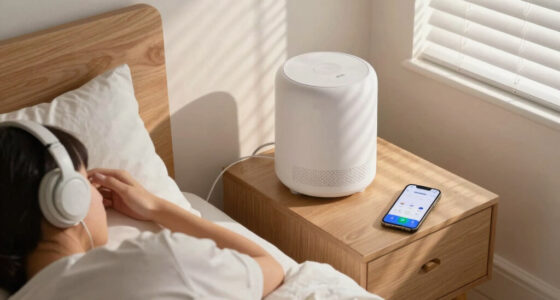

TL;DR
Open a free Amazon Business account
Business pricing, bulk buying and tax-exempt orders.
Create a free accountAs an affiliate, we earn on qualifying purchases.
Continuous sounds play without interruption, while looping sounds repeat in cycles, often with a perceptible seam. Advances in audio tech make seamless loops more natural, boosting immersion and comfort. Knowing how seams work helps you choose or create better sleep sounds.
Ever notice how some sleep sounds feel like one long, uninterrupted hum, while others have a faint repeating pattern that catches your ear? That tiny gap or noticeable repeat—the ‘seam’—can subtly disrupt your relaxation. Whether you’re using white noise, nature sounds, or ambient tracks, understanding the difference between continuous and looping sounds can change how peaceful your sleep environment feels. In this guide, you’ll learn what makes a sound seamless, how technology is making loops more natural, and practical tips to craft audio that fades into the background without a hitch.
Seams are tiny transition points in looping sounds that can distract or break your immersion.
Advanced editing techniques like crossfading and granular synthesis make loops sound more natural and seamless.
Choosing sounds with natural, less dynamic transitions reduces the chance of seams becoming noticeable.
Test your sounds at different volumes and environments to ensure the seams stay invisible.
AI tools are increasingly helping create near-perfect, imperceptible loops for better relaxation and sleep experiences.
Continuous vs. Looping Sounds: Hearing the Seam
Continuous audio feels like one uninterrupted environment. Looped audio repeats a finite recording—and when its ending fails to meet its beginning cleanly, the brain may notice the seam.
One stream—or one cycle repeated?
The issue is not whether a file repeats. It is whether the listener detects a change in texture, rhythm, loudness or phase at the repeat point.
Stable by nature
A refrigerator hum, sound generator or live environmental source continues without a designed restart. The listener perceives one evolving stream.
Efficient by design
A finite rain, wind or ambient recording repeats. It can feel continuous, but the join must conceal changes at the end and beginning.
The seam is an attention event. A click, sudden texture shift or recognizable pattern can prompt the brain to check what changed—adding cognitive load when the goal is to drift into sleep.
How technology hides the join
Modern workflows combine careful source selection with increasingly sophisticated synthesis. Each stage removes another cue that could reveal repetition.
Choose the loop point
Match quiet, stable regions with similar tone, energy and background texture.
Crossfade the edges
Fade the ending out while the beginning fades in, replacing a hard cut with a blend.
Align phase and grains
Phase matching prevents clicks; granular synthesis reshuffles tiny fragments into organic variation.
Refine with AI
Texture analysis can generate or repair transition material that resembles the surrounding sound.
The practical trade-off
Continuous sources offer natural stability. Loops offer compact delivery and creative control. Editing quality determines whether that efficiency costs immersion.
| Feature | Continuous sound | Looping sound |
|---|---|---|
| Perception | ✓ One unbroken stream | ~ Repeating cycle |
| Typical examples | Generator noise, appliance hum, live wind | App rain, ambient beds, repeating effects |
| Seam visibility | ✓ Usually absent | ~ Depends on editing quality |
| File efficiency | ✗ Longer recordings use more storage | ✓ Small file can play indefinitely |
| Production | Simple when the source is naturally continuous | Needs loop points, blending and testing |
| Relaxation impact | ✓ Stable and immersive | ~ Equally soothing when the seam is hidden |
10 ways to make the seam disappear
Evaluate sleep audio in the conditions where it will actually play. Headphones, speakers, room acoustics and volume can expose different problems.
Why a tiny edit changes the whole experience
Listen like an editor
A seamless loop does not need to be technically perfect. It needs to remain perceptually invisible during real listening.
How can I detect a seam?
Listen through headphones at several volumes. Clicks, sudden tonal shifts, repeated events or momentary dips reveal the restart.
Can I make seamless loops at home?
Yes. Basic audio editors can set loop points and crossfade overlapping edges. Careful listening matters more than expensive equipment.
Are continuous sounds always better?
No. A well-designed loop can be perceptually indistinguishable while using far less storage and bandwidth.
Does high fidelity guarantee seamlessness?
No. Fidelity helps preserve clean texture, but poor loop points remain audible. Source choice, phase and transition design are decisive.
What’s the real difference between continuous and looping sounds?
Continuous sounds are like the steady hum of a refrigerator or the gentle rush of wind—playing without any breaks or noticeable transitions. Looping sounds, on the other hand, repeat in a cycle. Imagine a rain sound that plays for a minute and then starts over. The key difference? Seamlessness. A truly seamless sound feels like one never-ending flow, while a loop can sometimes reveal its start and end, creating a tiny ‘seam’.
Understanding this distinction matters because it directly impacts how relaxed you feel. A continuous sound can create a stable, immersive environment, reducing cognitive load and preventing your brain from searching for changes. Conversely, detectable seams in loops can trigger minor distractions, pulling your attention away from relaxation and potentially disrupting sleep. This subtle difference can influence your overall sleep quality, especially if you’re sensitive to audio cues or prone to waking up easily. Therefore, investing in seamless sound design isn’t just about comfort—it’s a crucial factor in optimizing your sleep environment for restorative rest.
As an affiliate, we earn on qualifying purchases.
How do modern tech tricks hide the seams and make loops sound natural?
Creating a seamless loop isn’t magic—it’s smart editing and sound engineering. Techniques like crossfading blend the end of a sound with its beginning, smoothing out any harsh transition and preventing your brain from detecting a break. This method is vital because even small discontinuities can be perceived as an interruption, pulling your focus away from relaxation. Granular synthesis takes this further by breaking sounds into tiny fragments—called grains—and reassembling them with slight variations. This process mimics the natural fluctuations in real-world sounds, making the loop feel more organic and less mechanical.
For example, a rain loop might fade out during the last few seconds while fading in at the start of the cycle. When done well, it’s so smooth you can’t tell where one cycle ends and the next begins. Modern software also employs AI algorithms that analyze sound textures to generate near-imperceptible loops, effectively eliminating any audible seam. This technological edge means you can enjoy endless, natural-sounding environments that don’t distract or disturb your sleep, turning a simple sound into a powerful relaxation tool.
As an affiliate, we earn on qualifying purchases.
Why do seams matter when you’re trying to relax or sleep?
Seams can be tiny but mighty. A faint click or abrupt change in sound can distract your brain—especially when you’re trying to drift off. For instance, a looping sound with a noticeable seam might cause you to wake briefly or feel unsettled, defeating the purpose of calming noise. These small disruptions can trigger subconscious alertness, which is counterproductive when your goal is to unwind. Over time, even minor inconsistencies in sound can accumulate, leading to increased difficulty falling asleep or fragmented sleep cycles.
Research indicates that consistent, seamless sounds help lower cognitive arousal, allowing your mind to settle more quickly. Conversely, poorly crafted loops with audible seams can cause your brain to become hyperaware of the environment, making relaxation more difficult. Recognizing the importance of seamlessness isn’t just about comfort—it’s about optimizing your sleep quality by minimizing potential disturbances. When designing or selecting sleep sounds, prioritizing seamlessness ensures your environment remains tranquil, supporting deeper and more restorative sleep.
sleep sound with crossfading technology
As an affiliate, we earn on qualifying purchases.
As an affiliate, we earn on qualifying purchases.
10 tips to craft or choose the best seamless sleep sounds
- Use high-quality recordings or sound generators that support crossfading, as higher fidelity reduces the chance of perceivable seams.
- Choose sounds that naturally blend—like wind, rain, or white noise—where transitions are less noticeable because they mimic real-world environments.
- Set the loop points at natural pauses or less dynamic sections of the sound to minimize perceptible gaps.
- Apply crossfading or fade-in/fade-out effects in your audio editing software to mask any potential seams.
- Test your sound at different volume levels and environments—what sounds seamless at low volume might become noticeable at higher volumes.
- Use granular synthesis tools if available—these help create more organic, less detectable loops by adding subtle variations.
- Avoid abrupt sounds or sudden changes at the loop point, which are more likely to be detected by your brain.
- Familiarize yourself with AI tools that generate seamless soundscapes—these leverage advanced algorithms for superior results.
- Keep the overall sound environment simple—less variation makes it easier for the brain to accept the loop as continuous.
- Regularly update or refresh your sound library to incorporate new, more natural recordings, maintaining freshness and reducing familiarity fatigue.
As an affiliate, we earn on qualifying purchases.
Comparison table: Continuous vs. Looping Sounds
| Feature | Continuous Sounds | Looping Sounds |
|---|---|---|
| Perceived as | One unbroken stream | Repeating cycle |
| Common examples | Refrigerator hum, ocean waves | Rain in a sleep app, bird chirps in a loop |
| Seam visibility | Usually none | Depends on editing quality and techniques used |
| Audio file size | Typically larger | More efficient, smaller files |
| Ease of creation | Simple, naturally continuous | Requires careful editing, smoothing, or tech tricks |
| Impact on relaxation | Very natural, immersive experience | Potentially distracting if seams are noticeable, but achievable with proper editing |
Frequently Asked Questions
How can I tell if a sound is seamless or has a noticeable seam?
Listen carefully at different volumes and with headphones. A seamless sound should feel like a single, uninterrupted flow. Any tiny click or abrupt change signals a seam.Can I make my own seamless loops at home?
Absolutely. Basic audio editing software supports crossfading and loop point setting. With some patience, you can craft your own relaxing, seamless soundscapes.Are continuous sounds always better than loops?
Not necessarily. Continuous sounds are naturally seamless, but they can take more storage space. Well-edited loops can be just as soothing if the seams are hidden and techniques are properly applied.Do high-fidelity audio files matter for seamlessness?
Quality helps, but the key is how the sound is edited. Even high-quality files need proper editing to avoid perceptible seams that can break immersion.Can AI tools really help me create better sleep sounds?
Yes. AI can analyze sounds and generate or refine loops that are nearly impossible to detect, making your sleep environment more peaceful and seamless.Conclusion
Whether you prefer the pure simplicity of a continuous hum or the practicality of a loop, the goal is the same: a sound that melts into the background. When seams are well-hidden, they become invisible, letting your mind relax without interruption. Next time you set up sleep sounds, remember—small edits and smart choices make all the difference. Your perfect, seamless sleep soundtrack is just a few tweaks away.
Flea & tick season Picks
flea and tick prevention
As an affiliate, we earn on qualifying purchases.